My Story
“I am a holocaust survivor and I have a story that these young people want to hear.”

I was born in central Poland, the youngest child of a lumber yard owner. Life was idyllic until the Nazis invaded Poland when I was six years old. This began a six-year journey which included ghetto, slave labor, and concentration camps.
In 1945, after losing my mother, father, two siblings and many additional family members, my brother Isaac and I were evacuated to England as part of a program for Jewish refugee children. In 1951, I moved to the United States.
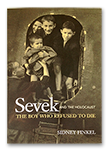
Since 1993, I have focused on Holocaust education, visiting classrooms and telling my story. My goal is to teach children about the horrors of the Holocaust and counter inhumanity and hatred with lessons that promote tolerance, understanding, compassion, courage and acceptance. My memoir, Sevek the Boy Who Refused to Die, details my journey.

I tell my story from the perspective of eight-year-old Sevek, with as much of the unvarnished truth as the audience can understand and tolerate. The students – especially those “at risk” – become completely absorbed in my story — appalled, inspired and curious, many finding parallels in their own lives.
In 2011, I was awarded an honorary doctorate degree from St. Xavier University in Chicago, and in 2013, I was awarded the Philip K. Weiss Award for Storytelling for Peace and Human Rights.
Childhood Horrors
Dec. 19, 1932 – Sidney Finkel was born Sevek Finkelstein in Piotrkow, Poland to Lieb and Faiga. The first few years of his life were spent as part of a normal, loving and fairly well-to-do family.
1939 (age 6) – After Nazi Germany invaded Poland, Sevek, his parents, his brother Isaac and his sisters Ronia, Lola and Frania were forced to moved into the cramped and disease-ridden ghetto in Piotrkow. His brother Isaac was sent to the Front with the Polish Army to fight the Germans, where he was shot and wounded. Back in the ghetto, all of the family’s possessions were confiscated, and the children were not allowed to attend school. But that was just the beginning of the atrocities Sevek would experience as a child.
1940 (age 7) – His eldest sister Ronia was discovered outside the ghetto giving birth to an infant boy. Ronia was shot dead in a cemetery by German officers after they had thrown the child out a window.
 1942 (age 9) – 90% of the Jews in the ghetto were herded into cattle cars and shipped to their deaths in the Treblinka concentration camp. Sevek’s mother Faiga and sister Frania were among the victims. Sevek, his brother Isaac, sister Lola, and father Lieb remained in the ghetto.
1943 (age 10) – Sevek, his father Lieb and brother Isaac were sent to a slave labor camp in Bugaj, Poland.
November 1944 (age 11) – Sevek, Lieb and Isaac were loaded into cattle cars and shipped to a much worse slave labor camp in Czestochowa, Poland.
December 24, 1944 (age 12) – Sevek, and Lieb arrive at the Buchenwald concentration camp in Germany. Lieb was moved three weeks later to the concentration camp Mittelbau-Dora where he died.
April 10, 1945 (age 12) – One day before Buchenwald was liberated by the Americans, Sevek, Isaac and 1,500 others were marched to Weimar, where they were loaded onto open cars. Over the course of three weeks, starvation and disease kiledl 1,000 of the prisoners.
May 1945 (age 12) Sevek arrived in Theresienstadt, Czechoslovakia, a concentration camp where the Germans had supposedly fled. There, he caught typhus and almost died. Fortunately, he survived. He was reunited with Isaac and Lola and they were finally freed.
Freedom

August 1945 (age 12) -Sevek and Isaac were flown to Windermere England with other young Jewish refugees as part of a group called “The Boys” “The Boys”. Later, he was sent to a boarding school called Bunce Court. He did not speak the language and since he had no schooling for six years, was basically illiterate. But because of the loving care of his teachers, he began to learn.
1951 (age 18) Sevek arrived in the United States joining his sister, Lola, and her family. He changed his name to Sidney Finkel and settled in Chicago, living with an uncle, where he began a successful career as a salesman and manager at an appliance store.
A Life Changing Event and Second Career
 Sidney did not begin talking about his experiences during the Holocaust until 1993, when visiting his pregnant daughter. It was then, while visiting the United States Holocaust Memorial Museum in Washington DC and with the suggestion of his son, he decided it was time to share his story publicly.
In April 2011 and 2015, Sidney returned to Buchenwald for commemorations of the concentration camp’s liberation. Click here for Return to Buchenwald Gallery.
Dedicated to education, Sidney received his GED at the age of 55. He received an honorary doctorate from St. Xavier University in Chicago in 2011. Click here for Commencement Gallery
 Sidney has served on the Advisory Board of Facing History And Ourselves, an organization that focuses on assisting school children in learning about the Holocaust and other major historical events and how to think about the moral decisions that both leaders and ordinary people make when confronted with prejudice, hatred, and temptations to de-humanize others.
In May of 2013, Sidney received the Philip K. Weiss Award for Storytelling for Peace and Human Rights, where he was introduced by two of his grandchildren. Click here for Phillip Weiss Award Gallery.
Now a widow, Sidney has five children, nine grandchildren and two great grandchildren. He currently lives with his companion Barbara, in Tucson, AZ where he is active in the JCFS of Southern Arizona’s Holocaust Survivor community.
Further resources regarding the Piotrkow Trybunalski and the young survivors who were transported to England include:
- A Tale of One City: Piotrkow Trybunalski, Edited by Ben Giladi, Shengold Publishers, Inc., New York (Amazon.com)
- The Boys: The Story of 732 Young Concentration Camp Survivors, Martin Gilbert, Henry Holt and Company, New York (Amazon.com)
- The Holocaust Education & Archive Research Team, www.HolocaustResearchProject.org
Email Sidney at Sevek42@gmail.com to learn more about how he can assist you with Holocaust Education in your classroom.